The AI Model Buffet: Why One AI Isn't Enough in 2026
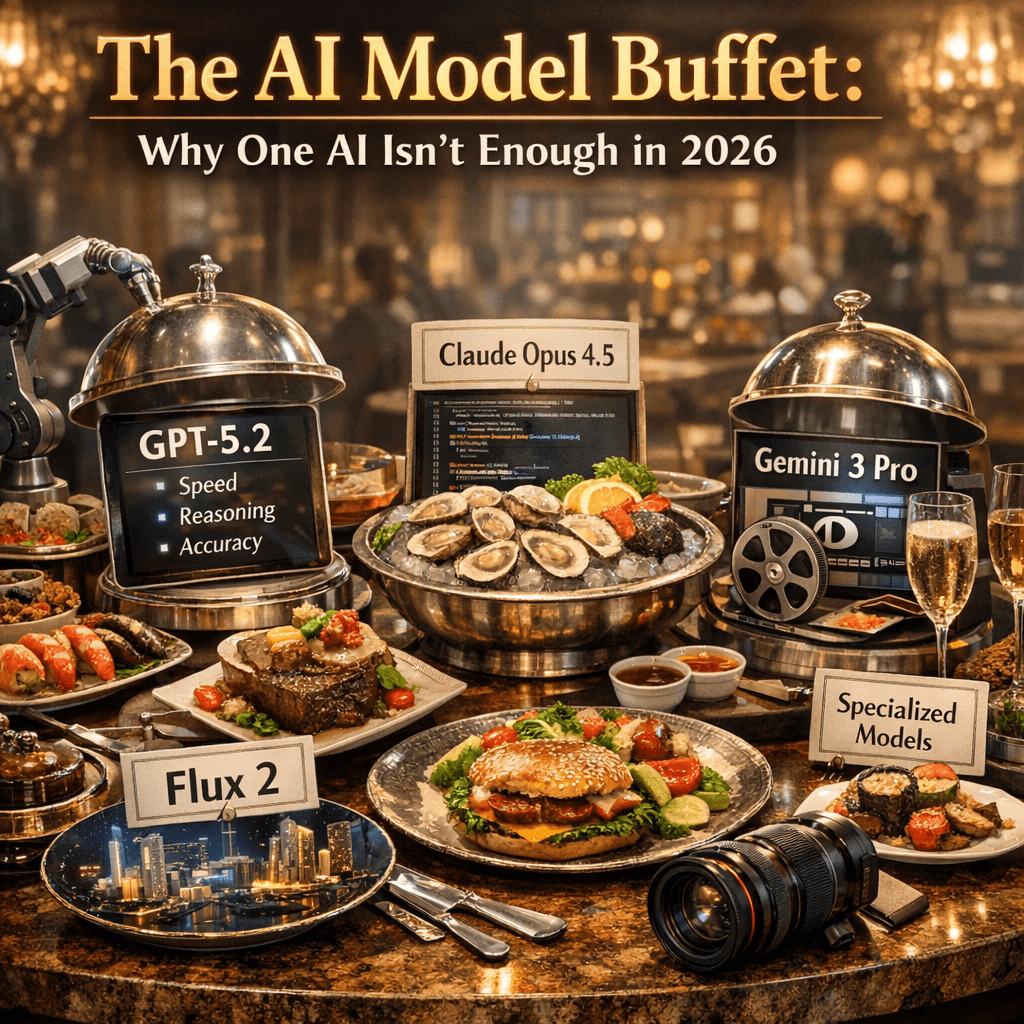
Here's a hot take that would have sounded insane two years ago: GPT-5 isn't always the best choice.
Neither is Claude. Neither is Gemini.
The "best" AI in 2026 depends entirely on what you're trying to do. And if you're still treating AI like a monolithic tool—one chatbot for everything—you're leaving massive productivity gains on the table.
Welcome to the AI Model Buffet era.
The End of the "One AI" Mindset
Remember 2023? Everyone was asking, "What's the best AI?" as if there was a single answer. ChatGPT versus Claude. Midjourney versus DALL-E. Pick a side.
That question is now as outdated as asking, "What's the best app on your phone?"
In early 2026, we have GPT-5.2 with three different variants optimized for speed, reasoning, and accuracy. We have Claude Opus 4.5 achieving a 77% score on coding benchmarks—the highest ever recorded. We have Gemini 3 Pro processing million-token contexts and handling video natively. And we have specialized image models like Flux 2 that make text rendering in images actually work.
The winning strategy isn't loyalty. It's knowing which tool to pull from the drawer.
Why Model Specialization Matters for Creators
Here's what Google found in their 2026 AI Agent Trends Report: 52% of executives using generative AI already have multiple AI agents in production. Not one agent doing everything—multiple specialized agents collaborating.
Why? Because the nature of creative work isn't monolithic either.
Think about your typical content workflow:
- Strategic thinking (what should I create?)
- Writing (drafting the actual content)
- Visual creation (images, graphics, thumbnails)
- Adaptation (repurposing for different platforms)
Each of these tasks has a different "shape." Strategic thinking benefits from models with deep reasoning chains. Writing benefits from models trained on natural language patterns. Image generation needs photorealism or stylization depending on the context.
Using the same AI for all of these is like using a hammer for every home repair. Sure, you can use GPT-5 to brainstorm, write, describe images, and plan your content calendar. But you're getting 70% performance across the board when you could be getting 95% on each task with the right specialist.
The "Intent-Based" Computing Shift
Here's what's really changing in 2026: we're moving from instruction-based computing to intent-based computing.
Old way: "Write me a LinkedIn post about my new ebook launch. Include a hook, three bullet points, and a call-to-action."
New way: "I'm launching an ebook for freelance designers. Get me engagement on LinkedIn."
The difference is subtle but transformative. Instead of telling the AI how to do something, you tell it what you want to achieve. The AI figures out the rest—including which approach, tone, and format will work best.
This only works when you have access to AI that understands your goal deeply. And that's where having a multi-model toolkit becomes essential.
Building Your 2026 AI Toolkit (Practically)
Let me get specific. Here's how I think about model selection for content creation:
For Strategy and Brainstorming
Use models with strong reasoning capabilities. Claude Opus 4.5 and GPT-5.2 Thinking both excel here.
On Typli's AI Chat, you can switch between GPT-5, Claude, and Gemini depending on the task. I use Claude for complex strategic questions where I need the AI to push back on my assumptions. I use GPT-5 when I need broader knowledge synthesis.
Try this: "Act as a content strategist. I run a newsletter for indie hackers with 5,000 subscribers. Identify three content angles I'm probably missing based on what's trending in early 2026."
For Writing and Copywriting
This is where specialization gets interesting. Generic chatbots can write, but purpose-built generators often produce better first drafts because they're trained on specific formats.
Typli has 185+ specialized generators for a reason. The Hook Generator isn't just "GPT with a prompt"—it's optimized for attention-grabbing openers. The Email Generator understands email-specific formatting and tone. The AI Text Generator handles versatile content needs.
The insight: A specialized tool with a narrower focus often beats a general tool prompted broadly.
For Images
The image generation landscape has shifted dramatically. Flux 2 has become the production standard because it finally solved the text-in-images problem that plagued earlier models.
Typli's AI Image Generator now includes Flux 2 alongside other models, letting you pick based on style. Need photorealistic? Different model. Need illustration style? Different model. Need consistent brand assets? Different model.
The key: Stop asking "what's the best image AI" and start asking "what style does this specific image need?"
For Repurposing and Adaptation
Here's where multi-model access really shines. A blog post needs to become:
- 5 LinkedIn posts
- An email sequence
- 10 Twitter threads
- A YouTube script
Each of these has different optimal lengths, tones, and structures. Using AI Writing Tools designed for each format produces better results than asking one chatbot to "rewrite this for Twitter."
The "Multimodal Pipeline" Is Here
One trend that's exploding in early 2026: multimodal content pipelines.
The idea is simple. You describe what you want to create, and AI handles text, images, and eventually video in one coherent workflow.
Adobe reported that Firefly users generated over 18 billion assets by late 2025. Google's Gemini and OpenAI's tools are seeing similar adoption. The creators winning right now aren't the ones who can write the best prompts—they're the ones who've built efficient pipelines.
Here's what a modern content pipeline looks like:
- Input: A single content brief ("I want to promote my new AI consulting course")
- Output: Blog article + social posts + email sequence + promotional images + landing page copy
All generated in under an hour using a combination of specialized tools.
This isn't science fiction. I've watched solopreneurs outproduce entire marketing agencies because they've mastered this approach. The rise of the AI Orchestrator is real.
The Human Edge in a Multi-Model World
If AI can do all of this, what's left for humans?
Taste and direction.
Here's what AI still struggles with in early 2026:
- Knowing what's actually worth creating (strategy at the highest level)
- Maintaining genuine brand voice (AI can mimic, but not originate)
- Connecting ideas in novel ways (AI recombines, humans synthesize)
- Reading the room (understanding your specific audience's unspoken needs)
The creators thriving right now aren't the ones who can write the most words. They're the ones who can orchestrate AI tools toward a coherent vision that feels human.
This is why "prompt engineering" as a skill is already declining. The new skill is AI orchestration—knowing which model to use, when to switch, and how to refine outputs into something cohesive.
Getting Started: Stop Being Monogamous with AI
If you're reading this and still using one AI tool for everything, here's your homework:
-
Audit your content workflow. What are the actual distinct tasks? (Brainstorming, drafting, editing, visualizing, distributing)
-
Match tools to tasks. Try Typli's AI Chat for strategy with different models. Use specialized generators for specific content formats. Use AI Image Generator for visuals.
-
Build a pipeline. What's your repeatable process from idea to published content? Where are the bottlenecks?
-
Iterate based on results. Track which AI tools produce outputs that need the least editing. Double down on those.
The Bottom Line
2026 isn't about finding the "best" AI. It's about building a toolkit of specialized capabilities that you can deploy strategically.
The creators who figure this out first will have an unfair advantage. They'll produce more, faster, with higher quality—not because they work harder, but because they've stopped asking AI to be something it's not.
One AI doing everything at 70% performance? Or five specialized tools each hitting 95%?
The math isn't hard.
Ready to build your AI toolkit? Explore Typli's full suite of AI tools and start working with the right model for every task.
Don't let complicated software hold you back. Step into effortless content creation with Typli and elevate your writing today. Experience AI content writing made simple.