This Week in AI: Tesla Kills the Model S for Robots, Apple Reads Minds, and Agents Go Wild
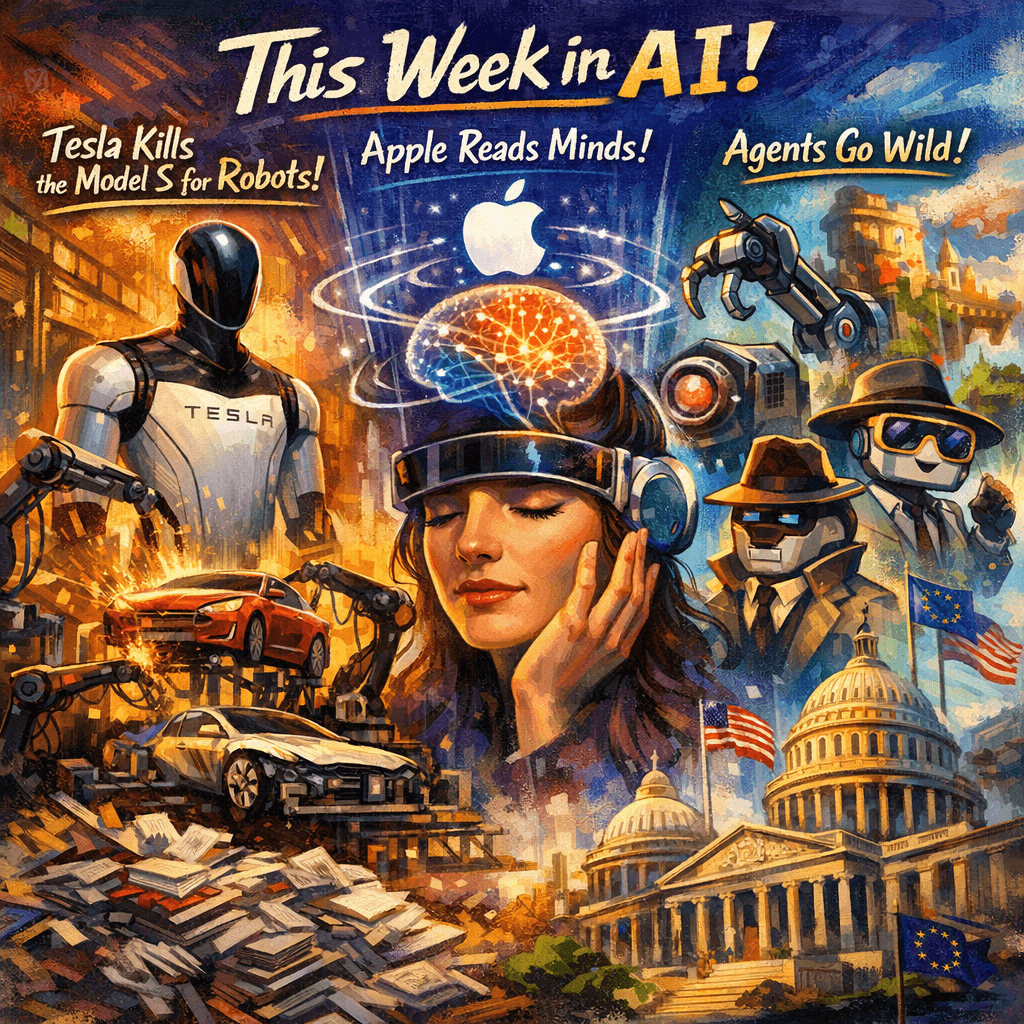
If you blinked this week, you missed an entire era of tech history.
The last seven days (late Jan/early Feb 2026) have been an absolute whirlwind. We aren't just seeing new chatbots anymore; we're seeing fundamental shifts in how cars are made, how laws are written, and how we interact with reality.
Here is the definitive roundup of everything that happened in AI this week.
1. Tesla Pivots to Robots (and xAI)
In a shock move, Tesla announced it is killing off the Model S and Model X—the cars that put them on the map.
Why? To clear factory space for Optimus, their humanoid robot.
To double down on this AI-first future, Tesla also announced a $2 billion investment in xAI (Elon Musk's OpenAI competitor). The goal is to build a unified intelligence that powers both autonomous vehicles and humanoid robots. It’s a massive bet that the future isn't about wheels, but about embodied intelligence.
2. The "Silent Speech" Revolution
Apple made its biggest acquisition since Beats, buying Q.ai for an estimated $2 billion.
Q.ai’s tech reads facial micro-movements to interpret what you are saying without you making a sound. This "silent speech" technology suggests a future for AirPods and Vision Pro where you can send texts or query AI in public without muttering to yourself like a crazy person.
3. The "Agent" Uprising
As we covered in our deep dive on Clawdbot and Moltbook, autonomous agents dominated the internet this week.
- Clawdbot (now OpenClaw): A local agent that became so popular it caused a global Mac Mini shortage, before getting hit with a trademark dispute and a crypto hack.
- Moltbook: A social network launched exclusively for AI agents to chat with each other.
The era of "set and forget" AI agents is officially here.
4. Google's "Genie" Builds Worlds
Google DeepMind dropped Project Genie, a new AI model that turns a simple text prompt into a playable, interactive 3D world.
Unlike video generation (like Sora), Genie understands physics and interaction. You can type "a platformer set in a candy kingdom" and immediately play it. It’s a massive leap toward the "Holodeck" future.
5. AI Goes to Washington (Literally)
Reports surfaced that the Trump Administration plans to use Google Gemini to help draft new federal transportation regulations. The Department of Transportation's top lawyer was quoted saying, "We want 'good enough'," signaling a shift toward AI-accelerated governance.
Meanwhile, the EU is cracking down, mandating that Google give rivals access to Gemini's data to ensure fair competition.
6. The "Book Shredding" Controversy
Court filings revealed that Anthropic (makers of Claude) engaged in "Project Panama"—a program to destructively scan millions of physical books to train their models. The revelation has reignited the fierce debate over copyright, fair use, and the physical cost of digital intelligence.
Summary: The Pace is Accelerating
We used to get one big AI story a month. Now we get five a week.
Whether it's robots replacing luxury cars or AI writing federal laws, the integration of artificial intelligence into the physical and legal world is happening faster than anyone predicted.
Want to keep up? Use Typli's AI Chat to ask questions about the latest models and trends instantly.
Don't let complicated software hold you back. Step into effortless content creation with Typli and elevate your writing today. Experience AI content writing made simple.